What Are Trolling Spoons?
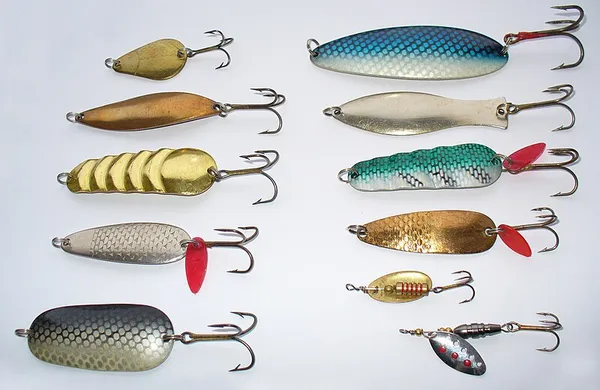
Trolling spoons are purpose-built for open-water trolling, where covering vast expanses of water at controlled depths is the name of the game. Unlike casting spoons, trolling spoons are typically thinner-gauge metal with a wider profile, designed to wobble enticingly at slow to moderate trolling speeds without the weight needed for casting distance. They run behind downriggers, dipsy divers, planer boards, or lead-core line setups that control their depth precisely. On the Great Lakes and large inland reservoirs, trolling spoons account for more chinook salmon, coho, and lake trout than any other lure category.
Sizes and Rigging
Standard trolling spoons measure 3-5 inches for salmon and trout, with smaller 2-3 inch models for walleye and brown trout. The thin metal allows a wide, rolling wobble at trolling speeds that thicker spoons can’t match.
Dodger and flasher combinations are a related trolling system. A dodger or flasher is mounted 12-24 inches ahead of a trailing fly, hoochie, or squid body. The attractor creates flash and vibration while imparting action to the trailing lure. Leader length between the attractor and lure is critical — too long kills the action transfer, too short restricts movement.
Downrigger setups are the most precise depth-control method. The spoon runs on a light leader clipped to a heavy cannonball that tracks at the exact depth shown on your sonar. When a fish strikes, the line pops free and you fight the fish without the weight.
How to Fish Trolling Spoons
Effective trolling is about putting the right lure at the right depth at the right speed. Use your electronics to find baitfish concentrations and the thermocline — the temperature break where game fish concentrate. Set your spoons at and just above the thermocline, staggering depths across multiple rods to cover the water column.
Speed control is critical. Small changes of even 0.2 mph can turn the bite on or off. S-turns — sweeping the boat in gentle curves — vary the speed of each lure, speeding up the outside rods and slowing the inside ones. This change of pace often triggers strikes from fish that were following but not committing.
Run a spread of colors and depths, then duplicate whatever is producing. Keep a detailed log of depth, speed, color, and water temperature for each fish caught.
When Trolling Spoons Shine
Trolling spoons dominate from spring staging through the summer thermal stratification period. In spring, salmon and steelhead cruise shallow — 10 to 30 feet — over warming nearshore waters, and trolling spoons behind planer boards cover that zone efficiently. By midsummer, fish push deeper following the thermocline to 40-80 feet, where downrigger-and-spoon setups are unmatched. Early morning and late evening bites are typically hottest, but deep-water trolling can produce all day when fish are concentrated on structure.